As we embarked on another day, we were aware of the news of Hurricane Sandy. It was driving up the eastern seaboard with an expectation that it would collide with the mainland in Maryland, New Jersey and New York. As of now, it was still offshore. But still, there is uncertainty with a hurricane and all we knew was we were heading toward it and not away from it. We crossed the North Carolina border into South Carolina heading toward Spartanburg and Greenville. The plan was to see several battlefields from the Revolutionary War, as well as Congaree National Park. We planned to slip back into North Carolina at Wilmington, then swing south along the coast. At this point we would be right in the midst of the wind and rain caused by the hurricane off the coast, we moving south as it moved north, hopefully leaving it behind us. Many important battles of the Revolutionary War took place in this part
of the country (see the movie "The Patriot"). Four of them were Kings
Mountain, Cowpens, Ninety Six, and Moore's Creek. We visited the sites
of all of them on the 26th. The Kings Mountain fight was one of the more
decisive patriot victories of the War. Cornwallis was enjoying a string
of victories in South Carolina and was preparing to invade North
Carolina in 1780. He sent British Major Patrick Ferguson to organize the
Loyalist militias to protect his flank. Ferguson issued a challenge to
the rebel militias to lay down their arms or suffer the consequences.
However, Patriot militias under several local leaders rallied and
caught Ferguson's forces completely by surprise at Kings Mountain,
killing or capturing most of them. Ferguson did not leave the
battlefield alive. Kings Mountain was a pivotal moment in the Southern
campaign. It greatly raised Patriot morale and with his Loyalist militia
destroyed, Cornwallis abandoned his plan to invade North Carolina and
retreated southward. The Cowpens Battlefield lies a short distance west of the Kings Mountain
site, along the freeway to Spartansburg. Cowpens was a popular grazing
site for cattle as they were being moved toward the population centers
of the coast. Here, in 1781, the cream of the British forces in the
south under Colonel Banastre Tarleton (the bad guy in "The Patriot")
were completely crushed by Continental forces commanded by General
Daniel Morgan. In fact, the final battle of the movie is loosely based
on what took place at Cowpens. Morgan came up with a tactical plan that
used the low opinion the British held of Continental militia against
them and it worked to perfection in leading Tarleton's forces into a
trap. This very important victory instigated a series of events that
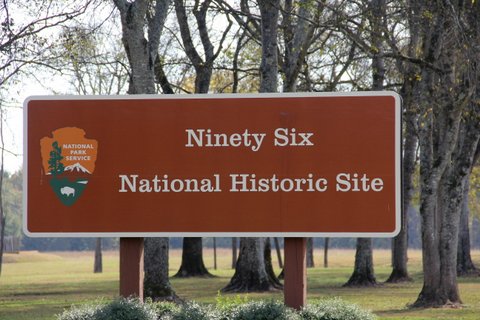
eventually led to the defeat of Cornwallis at Yorktown later in 1781. The Ninety Six NHS was the site of an important Loyalist\British fort
and settlement during the time of the fighting in 1780-81. General
Nathanael Greene laid siege to the settlement in the spring of 1781, but
was unsuccessful in taking the fort. After visiting Ninety Six, we headed east to take in Congaree National
Park. As we did so, the weather began to change dramatically as we
entered the outer fringes of Hurricane Sandy. The wind picked up, as did
our anxiety levels. Congaree National Park preserves the largest tract
of old growth bottomland hardwood forest left in the United States. It
consists of about 42 square miles and achieved its status in 2003, after
a grassroots campaign to save it was successful. Some of its trees are
the tallest in the Eastern U.S. and the park holds "world's biggest" of
several tree species. We enjoyed our walk along the elevated boardwalk loop through the swampy environment. Fortunately, the wind kept the
mosquitoes at bay. We
had a long, fast drive in the late afternoon trying to make it to the
Wilmington, North Carolina area before the Moore's Creek Battlefield
visitor center closed for the day. We arrived just in time, to find that
it had closed early due to Hurricane Sandy. We were able to look around
and see the outside exhibits. Moore's Creek was an important early
Patriot victory in 1776 in North Carolina of Patriot militia over
Loyalist militia that dashed the plans of the British governor to keep
the colony in British hands. Shortly after the battle, North Carolina
voted to declare independence. We stopped for the night just to the south of Wilmington. The wind and rain picked up as the evening progressed. We were up early the next day and sped south, hoping to slowly leave
Hurricane Sandy behind us as we went in the opposite direction. For the
most part this worked as the day wore on - we got wind and rain, but
nothing like what the Northeast was to experience in just a few days. It
also helped that the main center of the storm stayed offshore. We
crossed again into South Carolina and stopped at a very interesting
truck stop aptly named "South of the Border". As an extreme example of
freeway truck stops and intentional campiness, it is worth checking out
on your way through. You shouldn't have trouble finding it as signs will
let you know you are getting closer every step of the way. As we neared Charleston, we hit the peak of the rain and wind we would
experience from Sandy. We had a couple of things to see as we entered
greater Charleston from the north and made quick stops in the rain. The first was the home and farm of Charles Pinckney.
Pinckney fought in the Revolutionary War and became one of the principal
framers of the Constitution. He served as Governor of South Carolina, and as a
member of the United States Senate and the House of Representatives. He was
also President Thomas Jefferson's minister to Spain. We had planned to take the ferry to Fort Sumter (located on an island),
but the ferries were inactive due to the storm. Actually, Fort Sumter
National Monument has three units, which consist of the triangulation
points of the entrance to Charleston Harbor - Fort Sumter (the island)
and complexes on both the north and south hooks of the mainland. We
visited the complex on the north, the Fort Moultrie unit, and greatly
enjoyed the exhibits there. Adjacent to the visitor center is the
restored Fort Moultrie. It would have been nice to actually walk the
grounds of Fort Sumter, but getting an overall view of the history of
this area at Fort Moultrie (its history goes far beyond
the Civil War) was a good substitute. We stopped at the beach near Charleston to take some pictures of the
storm. Then, as we crossed the Cooper River on the Ravenel Bridge into
Charleston proper, the power of even the fringes of Sandy were fully
evident.